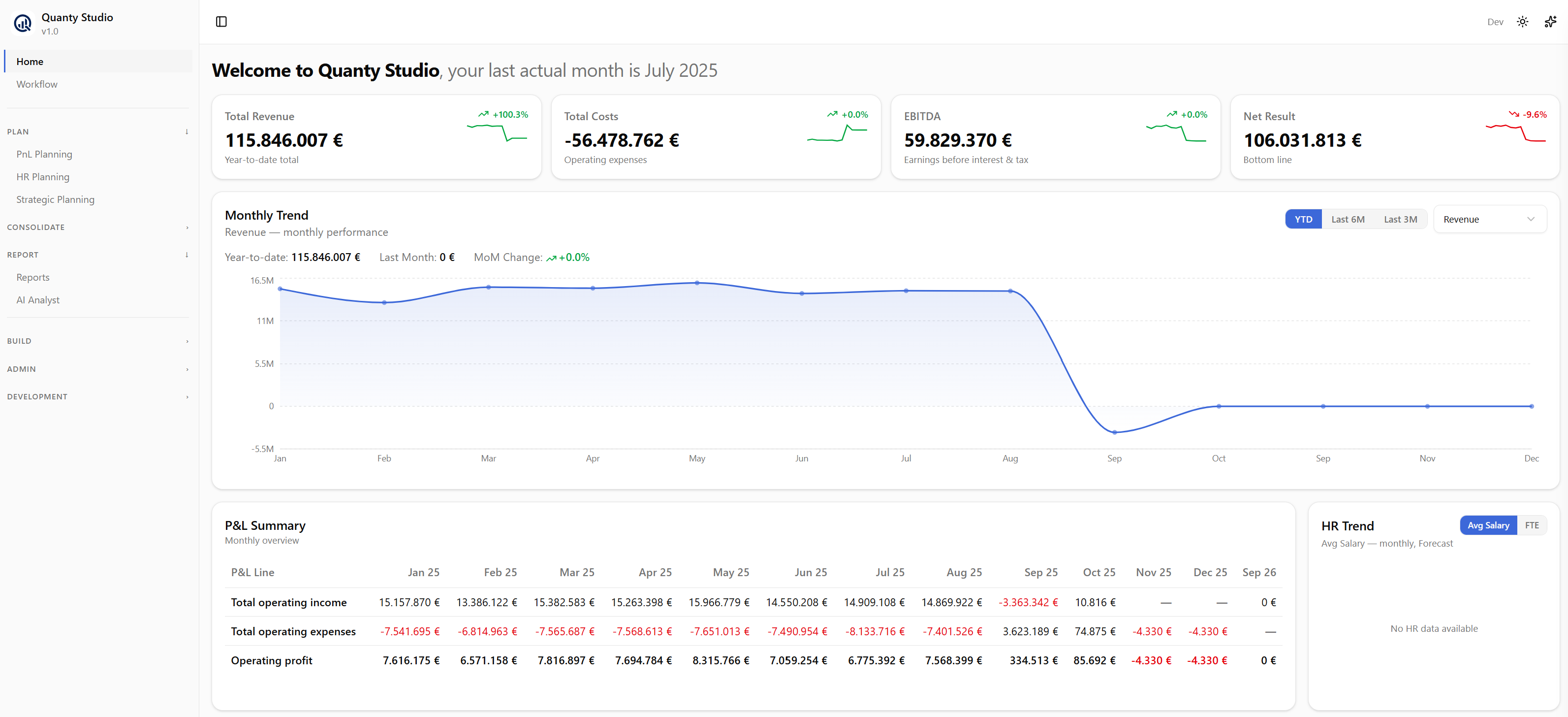
AI-native, not bolted on
Every workflow assumes the AI assistant is there — drafting, checking, answering. Not a chatbot pinned to the side of a legacy tool.
Quanty is the AI-native platform unifying planning, group consolidation, and reporting for enterprise finance teams — with AI assistants built into every workflow. You stay in control.
Founder-led onboarding. Direct line to the team that builds the product.
Quanty isn't an EPM platform with AI bolted on. It's AI-native from the foundation — built for enterprise finance teams operating at group scale. A different category of product than legacy EPM and the new wave of point tools.
Every workflow assumes the AI assistant is there — drafting, checking, answering. Not a chatbot pinned to the side of a legacy tool.
Built for groups with real consolidation, multi-currency complexity, and audit obligations — not for start-ups or single-entity SMBs.
Neither legacy EPM nor a single-purpose point tool. One AI-first platform for plan, consolidate, and report — at the scale finance actually operates.
Quanty doesn't just sit on your data. It learns your business, drives your processes forward, and shows up in the room when management decisions get made.
Quanty adapts to each customer's chart of accounts, entity structure, drivers, and reporting cadence — so its suggestions and analysis reflect your business, not a generic template.
The AI actively pushes finance processes toward best practice — flagging where your close, planning cadence, or controls are falling behind, and proposing the next step instead of leaving it to spreadsheet tribal knowledge.
Quanty doesn't stop at the report. It surfaces the call-to-action for the C-level — what to look at, what's drifting, what to decide — so finance shows up to the board with a recommendation, not just a number.
Quanty replaces the patchwork of planning, consolidation, and reporting tools — with AI assistants built into every workflow, not pasted on top. Budgeting and forecasting, group financial consolidation and management reporting for mid-market and enterprise finance teams, from Finnish groups with a handful of entities to listed companies.
Define the drivers, then connect the functional plans. Bring in the people who own each assumption. Run scenarios on the forecast you already have. Locked months, approvals and a history on every number make it safe to open the plan to the whole organisation.
Learn more about planning →A group close you can defend line by line. Close faster, open any consolidated figure to see what produced it, and consolidate budget and forecast exactly like the actuals. When the board or the auditor asks why, the answer is already there.
Learn more about consolidation →Actuals, budget and forecast side by side on one structure. Open a figure and see what it is made of. Ask in plain language why a line moved, or ask the Builder to build you a report — in seconds, not days of consultant work. The board pack refreshes instead of being retyped.
Most finance teams run planning in one tool, consolidation in another, and reporting in a third — then spend half the month reconciling between them. Quanty puts all three on one model, with one set of dimensions, one audit trail, one source of truth.
Actuals, budget, and forecast share the same dimensions. No mapping, no exports.
Every number traces back to source — including any AI-suggested adjustment, with the prompt and reviewer logged.
No CSV exports between systems. No reconciliation spreadsheets. No Friday-night discoveries.
Each assistant is built for a real bottleneck in the finance team's week — from setting up your planning model to drafting the variance commentary at close. Every output is reviewable, traced to source, and edited by you before it ever leaves the team. AI you can audit, not AI in a black box.
Profiles your business and drafts the FP&A plan — before week one.
Designs the planning model so the team can plan, not architect.
Move data in without filing an engineering ticket.
From idea to board-ready view in minutes.
The senior analyst on your team — minus the back-and-forth.
Lighter EPM tools punt integration and MDM to a separate stack. Quanty ships both — so your data lands clean, your dimensions stay consistent, and the AI has something coherent to reason about.
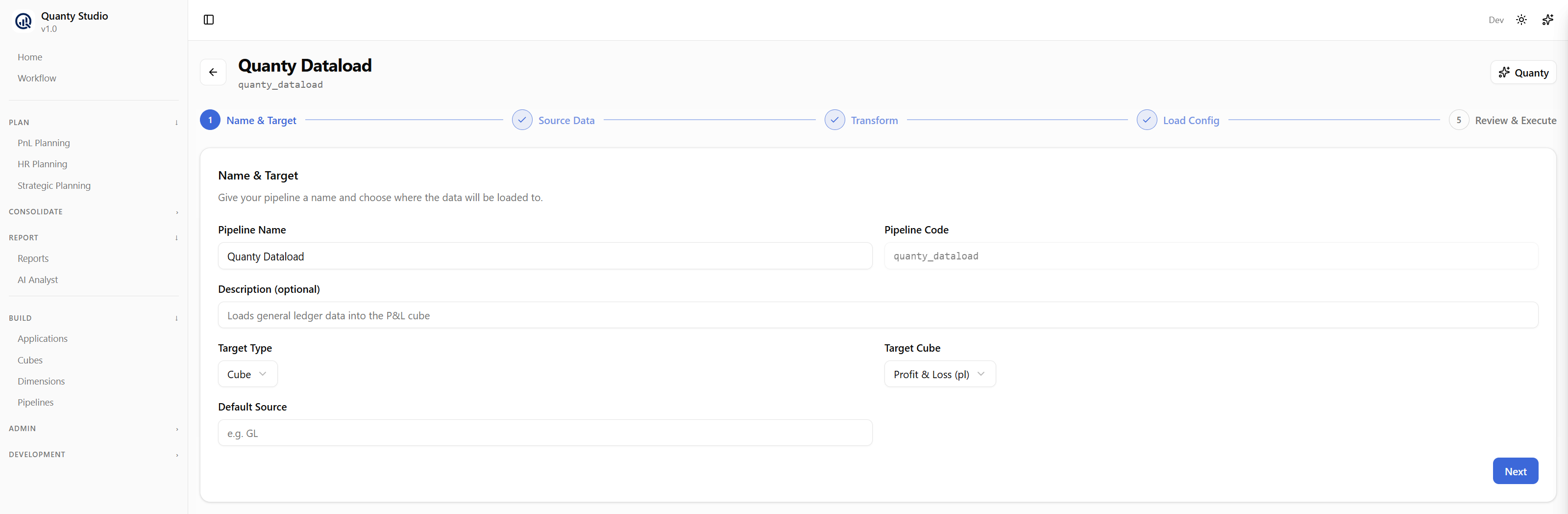
Visual pipelines for ERP, GL, HRIS, and CRM extracts. Schedule loads, watch staging tables, run AI-suggested transforms — without filing an engineering ticket.
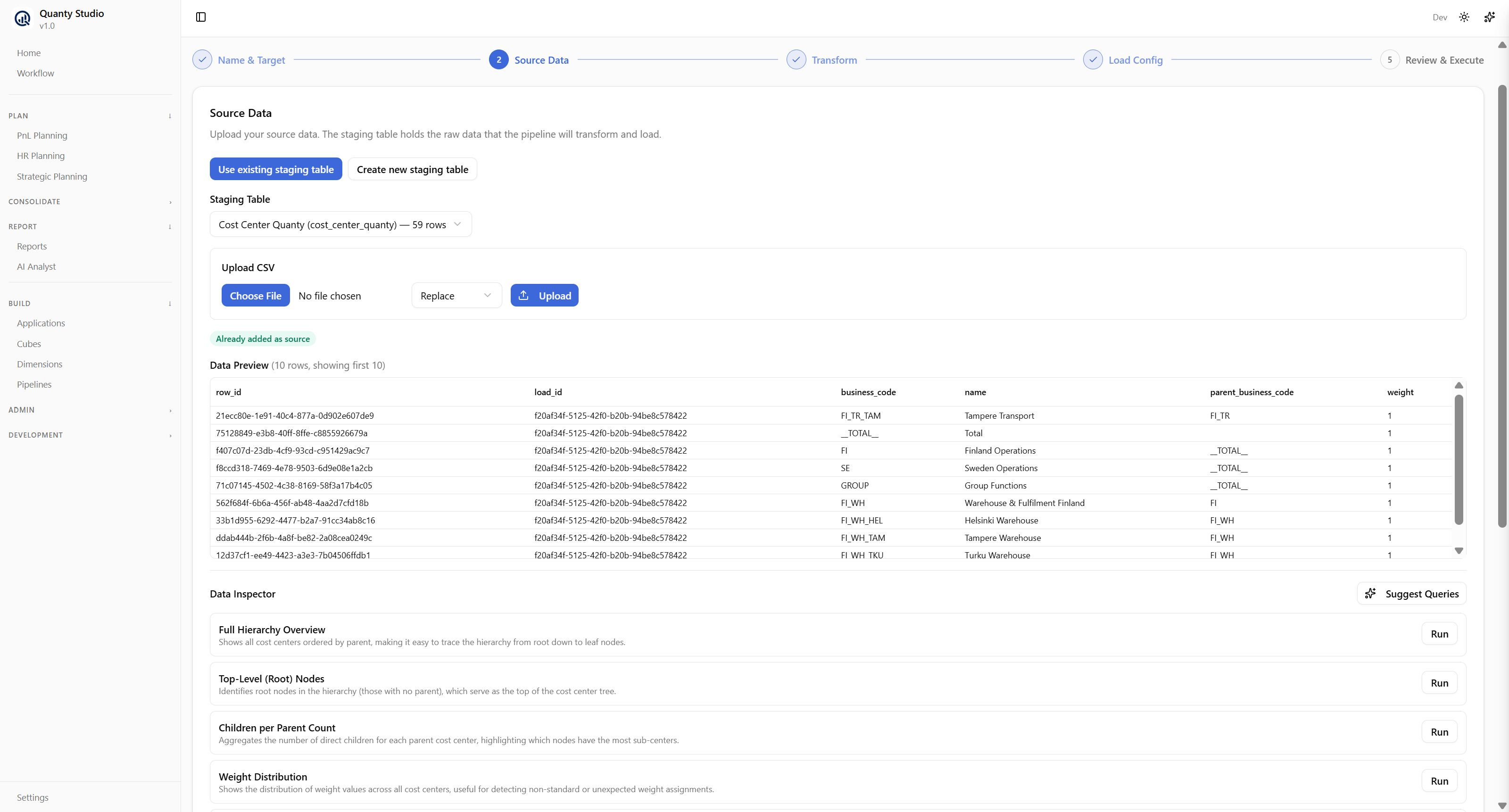
Cost centers, entities, accounts, and hierarchies live in one governed model. Audit trails on every change, version history, and AI-driven validation against your source systems.
Formulas live on the accounts finance already owns, not in a separate model someone else built. Units times price, headcount times salary and cost of sales as a share of revenue are calculated at the detail level and then add up, so changing an assumption moves the lines that depend on it. You can read the formula in a screen and change it there.
Yes. Finance builds pages for the people who own each assumption, filtered to their own part, and collects their contributions through a round with commit and approve steps. Workforce, sales, demand, cash flow, capex and scenario models are built in Quanty as models in their own right, and formulas read across them. See how planning works in Quanty.
No. Each model carries the dimensions it needs: sales might plan by product and region while workforce plans by role and entity. What is shared is the definitions underneath, so an entity or a cost centre means the same thing everywhere and the results come together.
Keep Excel. The grid is Excel-style in the browser, and the add-in lets budget owners work in Excel itself against the same numbers and the same locks. What you give up is the emailing, the version confusion, the accidental overwrite and not knowing who changed what.
It runs on the same platform and the same structure, so the group budget consolidates with the same ownership shares, eliminations and currency translation as the actuals. That is what makes a group forecast comparable to the group's reported figures rather than an approximation of them. See how consolidation works in Quanty.
Quanty is built for mid-market and enterprise finance teams: companies from roughly 100 employees up to the largest Finnish and Nordic groups, with anywhere from a handful to a couple of hundred legal entities. Because it is quick to implement it works for smaller groups too. If you have hundreds of entities and regulatory filings in many jurisdictions, ask us and we will tell you honestly.
It explains, or proposes a formula, a report or a model to build. A person reviews and publishes. The calculation engine follows defined rules, and every value has a person or a logged process behind it.
Yes. Quanty ships an MCP server, so agents your organisation already runs can ask Quanty for figures and explanations. They work under the same permissions as the person running them, and they read rather than write.
In your own database, in the EU, behind your own subdomain. Nothing is pooled with other customers.
A fraction of the time a legacy EPM project takes: weeks, not the year-long programmes those tools are known for. The exact timetable depends on the source data, the mappings, the planning models and the consolidation requirements, so we agree the responsibilities, the validation steps and the schedule with your team before starting rather than quoting an average.
Plan, consolidate, and report in one platform — with AI assistants built into every workflow. Founder-led onboarding and a direct line into the roadmap.
Get startedTell us about your finance stack and what you're trying to fix. You get founder-led onboarding and direct input into the roadmap; we get to see how Quanty fits real group-finance workflows. No long forms, no commitments — just start a conversation.
We read every message ourselves and will reply within two business days. If it looks like a fit on both sides, we'll set up a 30-minute call with the founding team to walk through your stack and goals — no commitment.